


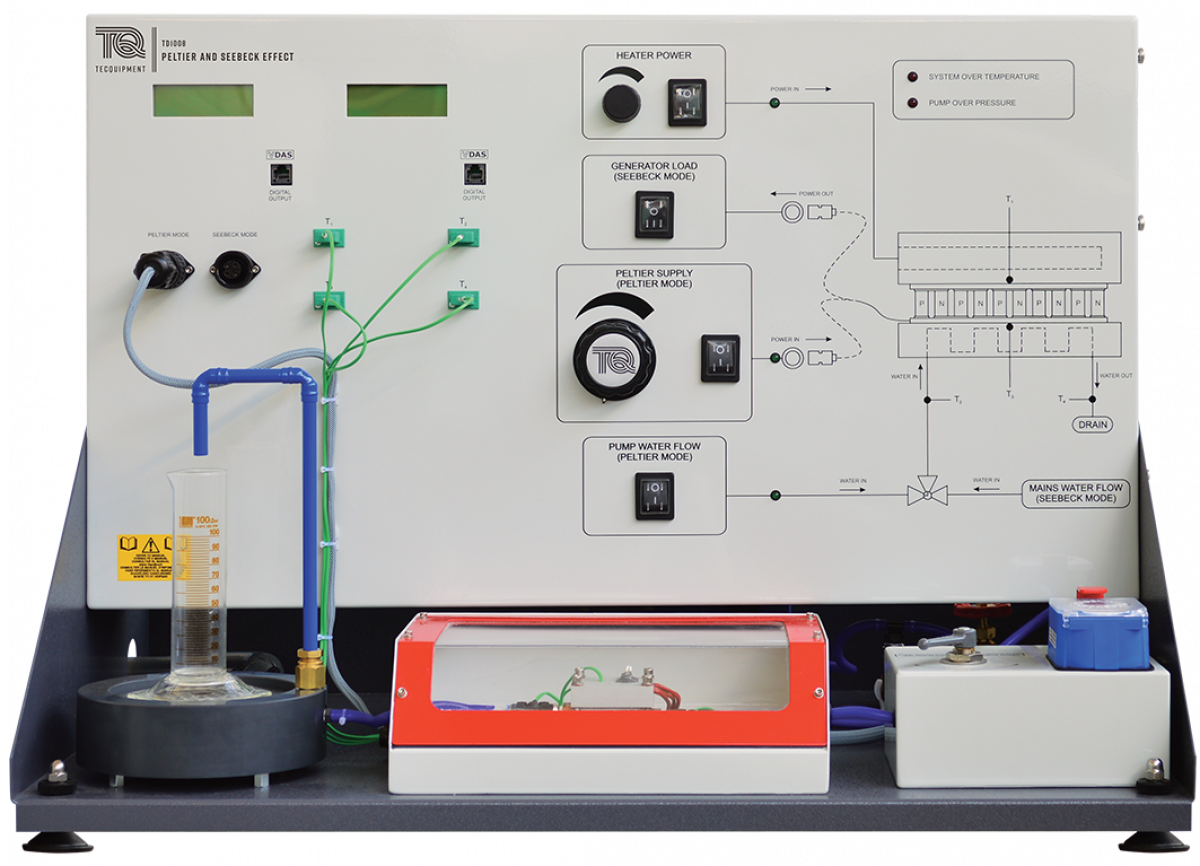
Peltier and Seebeck Effect
(Peltier And Seebeck Effect)
Key features:
- A bench-top unit to demonstrate a thermoelectric device – designed for teaching
- Connects for both Peltier or Seebeck tests – giving a full set of experiments
- Schematic diagram and transparent guard to help students understand the device construction and allow simple demonstrations
- A switchable load, variable heat source and device power supply for multiple test conditions
- Simple and safe to use – needs no tools
- Clear, multiline digital displays of all readings – you do not need a computer to work it or collect data
Description:
- The TecQuipment Peltier and Seebeck Effect Apparatus
shows how one of these devices work and tests its
performance when connected in a choice of two modes:- Heat to electricity for power generation when used
in Seebeck mode – often used for thermoelectric
generation and given the acronym ‘TEG’ (Thermoelectric Generator). - As an electrically powered heat pump when used in
Peltier mode. Often used in thermoelectric cooling and
given the acronym ‘TEC’ (Thermoelectric Cooling).
- Heat to electricity for power generation when used
- Students then learn to analyze its performance in both
modes, analyzing several factors including coefficient of
performance (COP) and energy balance. - For the Seebeck tests, the equipment uses an external
cold water source and variable power electric heater
to create a temperature difference across the device.
The device then converts this into an electrical potential
difference (voltage). A switch allows tests with and without
an electrical load. The load allows generated power to
flow and be measured for a range of applied temperature
gradients. - For the Peltier tests it also uses the electric heater, but with
a small water storage tank and water pump, creating a
stable, fixed-flow water supply. A variable voltage supply
controls the electrical power into the device. A calibrated
vessel allows students to measure the fixed water flow
accurately, for calculation of the heat pumped at the ‘cold’
side of the device. This allows assessment of the device
performance over a range of temperature gradients and
electrical power inputs. - A hand-operated valve allows the user to change the
water source without the need to reconnect pipes.
Students need no tools to do the experiments. - Thermocouples measure temperatures near to the surface
of the device and at the inlet and outlet of the water circuit. - Clear, multiline digital displays show all temperatures
and electrical measurements around the device, such as
voltage, current and power. - The equipment control panel includes a schematic
diagram of the device. A transparent guard covers the
device. These allow students to understand the device
construction and view ‘frost’ formation in simple cooling
demonstrations.
Learning Outcomes:
- Seebeck coefficient and the performance of a thermoelectric generator (TEG)
- Peltier heat pump tests and the performance of a thermoelectric cooler (TEC)
- Coefficient of performance (COP) and energy balance
- Comparisons of manufacturers data, theoretical performance and results from experiments
- Observation of the Lenz and Thomson effects
- Simple cooling demonstrations (determined by local conditions)
Specifications
Dimension (WxLxH): 810 x 500 x 600 mm
Weight: 47 kg
For details see the catalog below: