


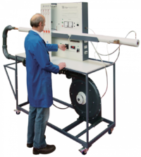
Forced Convection Heat Transfer
Key Features:
- Constant-speed fan with variable flow-control valve – for better flow control
- Heater interlock for safety
- Includes Pitot tube traverse for velocity profile measurements and traversing thermocouple to measure temperature distribution across the test pipe
- Includes thermocouples along the test pipe to measure heat transfer
- Accurate digital display of temperatures
- Includes manometers and an orifice to measure pressures and air flow rate
Description:
- A basic knowledge of forced convection heat transfer theory is valuable in many engineering fields, especially heat-exchanger design. TecQuipment’s Forced Convection Heat Transfer apparatus allows students to examine the theory and associated formulae related to forced convection in pipes
- It is a frame holding a motor-driven fan, piping and
instrumentation panel - The fan runs at a constant speed and draws air through a control valve. The air then moves into a u-shaped pipe. An orifice plate in the pipe connects to a manometer on the instrumentation panel to measure the airflow rate. A larger manometer on the instrument panel measures the fan pressure drop.
- The u-shaped pipe connects to a smaller diameter insulated and electrically heated copper ‘test pipe’.
- Students control the power input to the test pipe heater using a variable transformer, while noting the power using instrumentation on the panel. The test pipe discharges to atmosphere.
- Pressure tappings each end of the test pipe connect to a manometer on the instrument panel to measure test length pressure drop.
- A thermometer measures the air temperature at the inlet to the test pipe
- Further thermocouples measure temperature at various points within the test pipe insulation
Learning Outcomes:
- Derivation of the value of Nusselt number (Nu) and comparison with empirical formula
- Calculation of the local heat transfer coefficient (h)
- Determination of the Stanton number (St)
- Calculation of the friction factor (f) and comparison with experimental value
- Determination of the validity of the Reynolds analogy for air
Specifications
Electrical Supply:
- Three-phase, 380/440 V, 50 Hz, 10 A
Floor space needed:
- 4.8 m x 1.9 m
Test pipe length: 1.75 m
Test pipe diameter: 32.6 mm
For details see the catalog below: