


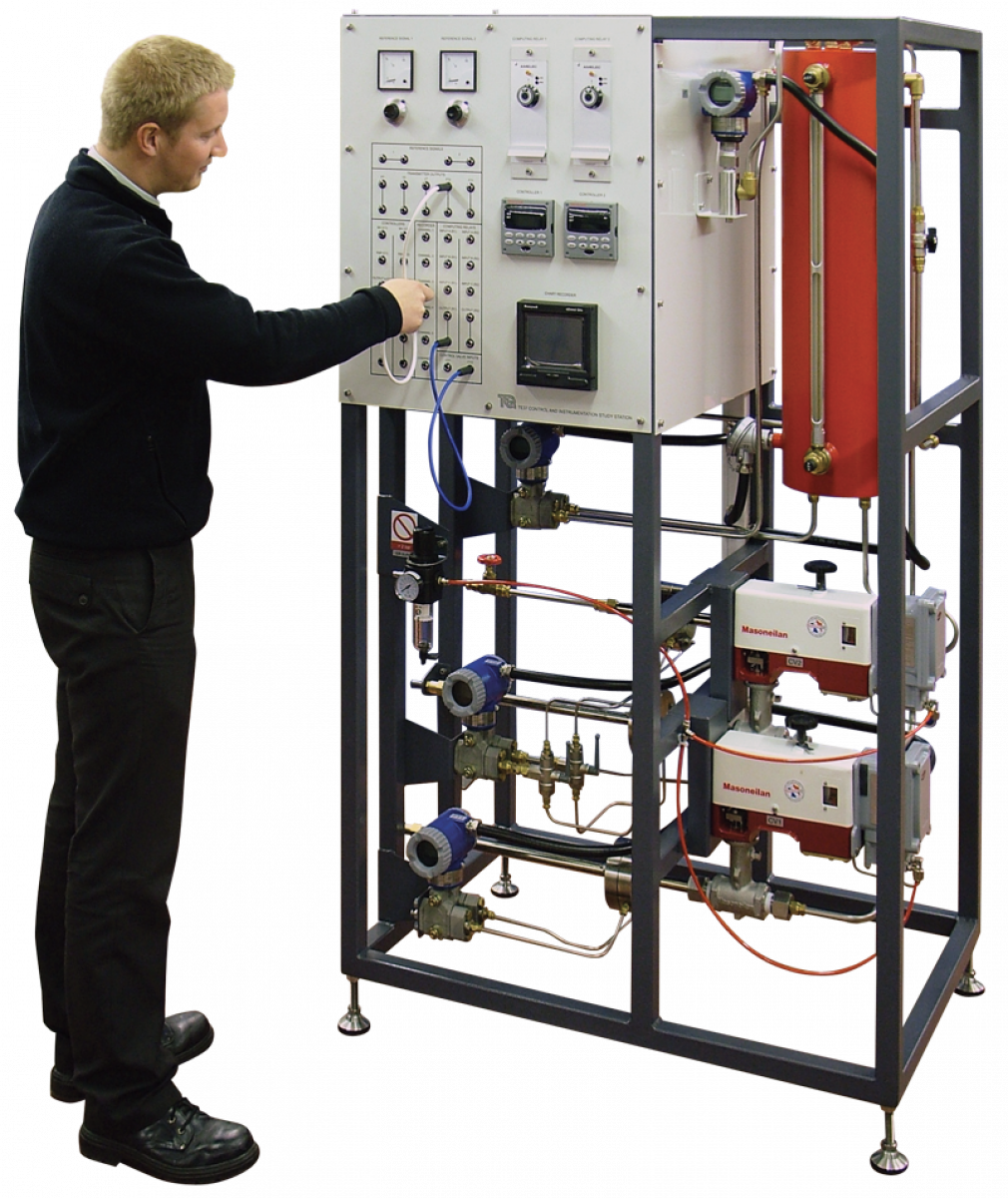
Control and Instrumentation Study Station
Key Feature:
- Genuine industry-standard instruments and controls
- Patch panel with leads for quick and simple connection between instruments, valves and controls
- Optional distributed computer control (TE37DCS)
- Gives academic and vocational study for process control engineers and plant technicians
- Includes hidden switches to create faults for fault-finding training
- Fully programmable controllers with local and remote set points, and fully programmable proportional, integral and derivative control
- Shows basic and advanced control, from standard flow control to ratio and interactive control
Description:
- The Control and Instrumentation Study Station uses industry-standard parts to teach industrial process control. It is an excellent tool to help train plant technicians and process control engineers.
- Hot and cold water supplies connect to the study station. Two valves (worked by compressed air) control the flow of the water supplies into a process vessel. The process vessel has three jobs:
- A pressure vessel with a pressure-relief valve for safety
- A temperature mixing chamber for the hot and cold water flows
- A liquid-level reservoir with a sight gauge
- Transmitters on the pipework and process vessel send flow, level temperature and pressure signals to a patch panel. Other sockets on the patch panel connect to the valves and other instruments. The students use leads (included) with the patch panel to connect the instruments and valves for any particular experiment.
- The study station includes two fully configurable controllers, each with remote or local set point inputs. The controllers are industry-standard, with a choice of different control methods, and fully adjustable proportional, integral and derivative (PID) circuits. Sockets on the patch panel connect to an electronic multi-channel recorder to log changes in process variables.
Learning Outcomes:
- Setting up process transmitters
- Level, pressure, flow and temperature control
- Cascade control
- Coupled and decoupled interactive control
- Ratio control
- Feedforward control
- Feedforward/feedback control
- Split range control
- Fault finding
Specifications
- Dimensions and weight: 1850 mm x 1100 mm x 750 mm and 272 kg
- Reference signals: 2 x adjustable reference signals, 4 to 20 mA
Transmitters
- Pressure and temperature transmitters
- Level transmitter (by differential pressure)
- 2 x flow transmitters (by differential pressure at orifice meters). One flow transmitter connects to the hot water inlet or to the process vessel drain
Controllers:
2 x electronic controllers with numeric displays. Remote or local set point and two outputs. Can be set for different control methods:
- Manual
- Proportional (P)
- Proportional and integral (PI)
- Proportional, integral and derivative control (PID)
PID values may be set by the user or found by the
controller’s automatic tune. Local set point is at the keypad on the controller. Remote set point and all inputs and outputs are connected at the patch panel.
Computing relays:
- 2 x arithmetic units
Each unit has a multiplier (k) and accepts three inputs (A, B and C), to give an output of B+k(A–C). All inputs and outputs are connected at the patch panel and operate with a 4 to 20 mA current signal.
Multichannel recorder:
- Six inputs (4 to 20 mA) connected at the patch pane
Process vessel:
- Cylindrical steel chamber with hot and cold inputs, outlet (drain) and overflow. Includes a 2 bar pressure-relief valve for safety and a transparent sight gauge to its front.
For details see the catalog below: